Why Healthcare AI Works in Fertility Care: Trust, Understanding, and Emotional Intelligence
Healthcare AI does not succeed because the underlying technology is advanced. It succeeds when patients and providers trust it. That distinction sounds simple, but it explains why so many clinics (including fertility clinics with real, pressing needs) hesitate to adopt AI even when the model behind it is impressive.
A fertility clinic doesn't ask "how sophisticated is this system?" It asks: will this be reliable at 11 p.m. when a patient is scared about a symptom? Will it know when to hand a conversation to a nurse instead of guessing? Will our staff still recognize their own workflow next week? Those questions, not benchmark scores, determine whether AI gets adopted, and whether it stays adopted.
The Real Barrier Isn't the Technology
Clinics do not avoid AI because they dislike innovation. They avoid it because implementation risk in healthcare is real. Patient trust can be lost in a single bad interaction. Workflow disruption slows down already-stretched staff. Compliance concerns are not abstract, they involve protected health information and regulatory exposure. Staff adoption requires people to change habits built over years. And inconsistent outputs, even occasional ones, are enough to make a clinical team stop relying on a tool altogether.
This is the paradox many fertility clinics live with: communication overload and administrative burnout are already hurting the patient experience, yet the perceived risk of adding AI can feel larger than the pain of the status quo. That hesitation is not irrational. It reflects the fact that most healthcare AI has been evaluated on what it can automate, not on how safely it fits into an existing standard of care.
The future of healthcare AI belongs to systems built around that reality: ones that integrate smoothly, reduce friction rather than add it, support staff instead of working around them, and make patient communication more consistent without disrupting the clinical relationships already in place.
Understanding Over Efficiency
Once implementation risk is addressed, the next question is what the AI should actually optimize for. Speed and automation have dominated the conversation, but in fertility care, what matters most to a patient is whether they understand their treatment, their medications, their next steps, and what to expect.
A patient who receives a fast answer but still doesn't understand their protocol hasn't been helped. They've been processed. A patient who understands why a medication timing matters, what a delayed cycle might mean, or what happens next after a procedure is a patient who feels more confident, more engaged, and better supported through a process that is often confusing and emotionally loaded.
This is why healthcare AI should be measured by the understanding it creates, not only the efficiency it delivers. Clear answers, consistent fertility education, and guidance available between appointments change how a patient experiences their entire journey: not just how quickly their question gets a response.
Emotional Intelligence Is Becoming as Important as Technical Intelligence
Patients don't remember how fast a response was. They remember whether they felt understood. That single observation is reshaping what "good" healthcare AI looks like.
The next generation of healthcare AI won't just answer questions: it will provide reassurance, context, and support during some of life's most uncertain moments. In fertility care specifically, patients need guidance between appointments, not just information delivered on demand. A missed period, a confusing lab result, or a hard day mid-cycle calls for a response that acknowledges the person, not just the query.
This doesn't mean AI replaces human care. It means AI can help make care feel more human, present in the gaps between appointments, when a nurse or physician isn't available but a patient still needs to feel heard. Emotional intelligence, alongside technical intelligence, is what determines whether an interaction leaves a patient more anxious or more supported.
How Trust Is Actually Engineered
Trust isn't a marketing claim. It's a property that has to be built into how a system behaves, every time. Three things create it:
- Consistency. The same question should get a consistent, clinically sound answer regardless of channel or time of day. Patients and staff both lose confidence in a system that contradicts itself.
- Knowing when to escalate. An AI system that recognizes the edge of its own competence, and hands off to a human care team when a situation calls for it, is far more trustworthy than one that tries to answer everything itself.
- Clinician oversight and guardrails. Healthcare AI should operate within boundaries clinicians define, not boundaries the AI infers on its own. That oversight is what allows a system to be AI-supported without ever becoming AI-replaced.
Trust, in other words, comes from experiences that feel reliable at every interaction: not from any single impressive answer. The future of healthcare AI will be defined by that reliability. Technology should strengthen patient confidence, not substitute for the human care experience patients still expect and deserve.
How Fertiligent Is Built for This
Fertiligent is built around trust, understanding, and emotional intelligence as design requirements, not afterthoughts. It operates as an AI operating system for fertility clinics: one clinic-governed AI agent working consistently across phone, fax, SMS, web, and email, so patients get the same reliable experience regardless of how they reach out.
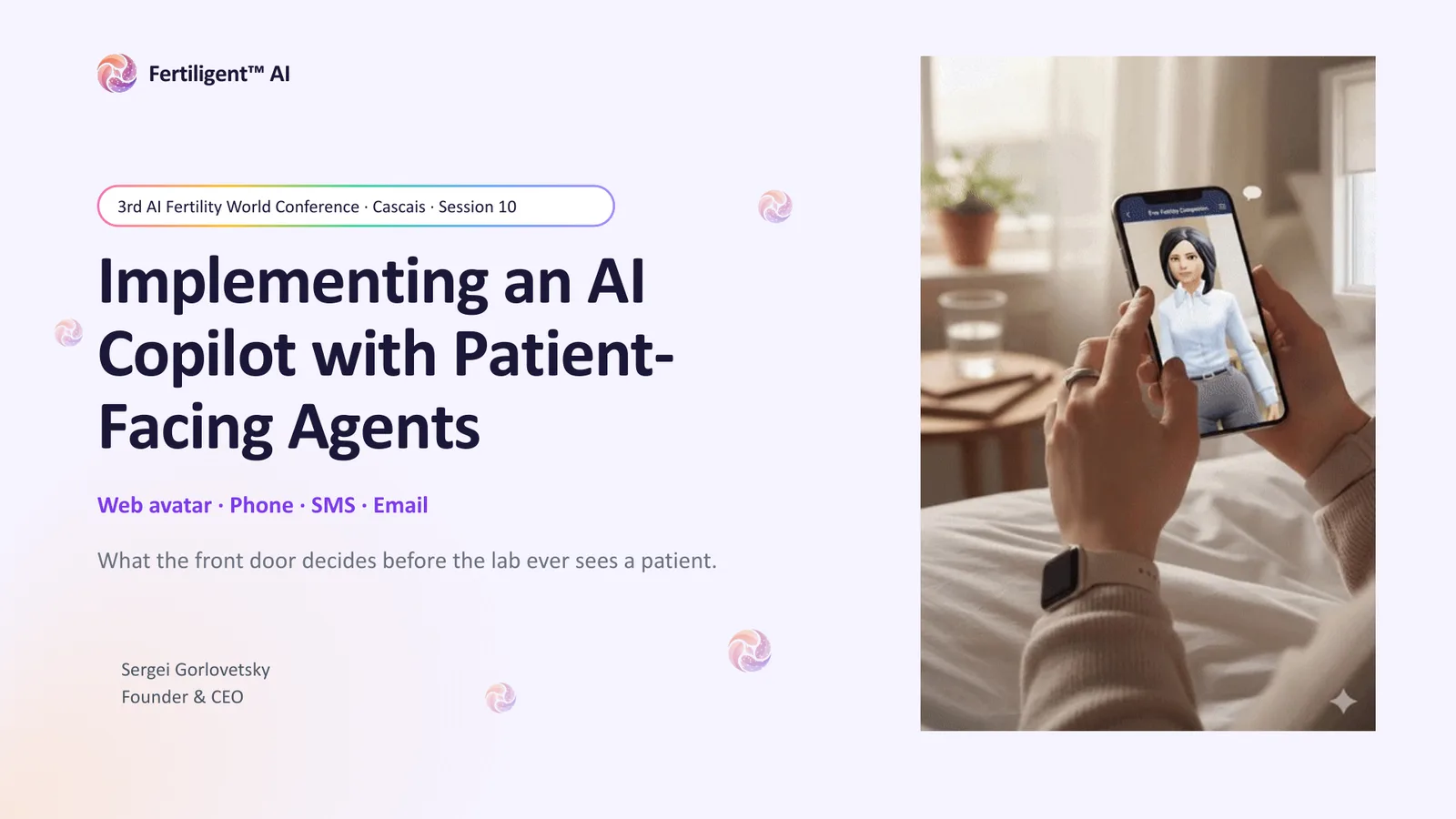
At the patient-facing layer, Eva, the patient companion, offers 24/7 plain-language support in 10+ languages, trained specifically on fertility care so guidance stays clear and clinically grounded rather than generic. When a conversation calls for a human (a concerning symptom, a complex clinical question, an emotional moment that needs a person); Eva escalates to the clinic's human care team. The clinic governs the system throughout: it works within clinic-defined boundaries, clinical judgement stays with the care team, and it is built with privacy-first compliance across HIPAA, GDPR, and PIPEDA.
That combination (consistency across channels, clear escalation paths, clinician oversight, and genuine fertility expertise) is what allows patients to trust the guidance they receive and actually understand what it means for their own care.
The Bottom Line
Advanced models are not in short supply. What's in short supply is healthcare AI that clinics can trust to behave consistently, that knows its own limits, and that helps patients understand their care rather than just process it faster. That is the bar fertility clinics should hold any AI system to, and the bar Fertiligent is built around.
Ready to see what trustworthy, fertility-trained AI support looks like in practice? See how the AI fertility companion works inside a clinic, try Eva, or talk to our team about bringing it to your clinic.
Related Reading: