
Blog
Insights & Stories
Practical guides for clinic teams, and essays on where fertility care is going.
Looking for product release notes, what shipped in each version? See the Fertiligent Release Notes.
Featured posts

AI in Fertility Clinics: Benefits, Implementation, and ROI
Discover how AI assistants are changing fertility clinics with automated documentation, patient support, and evidence-based decision support. Learn implementation strategies and ROI benefits for modern fertility practices.
AI medical scribes for IVF clinics compared (2026): fertility-specific vs general
Abridge, Dragon Copilot, Freed, Heidi, Nabla, Suki and Fertiligent Scribe, on the dimensions that matter to a fertility practice, cycle context, referral OCR, call capture, EMR write-back, data residency, consent and pricing transparency. Every claim from the vendor's own pages, checked 31 August 2026.
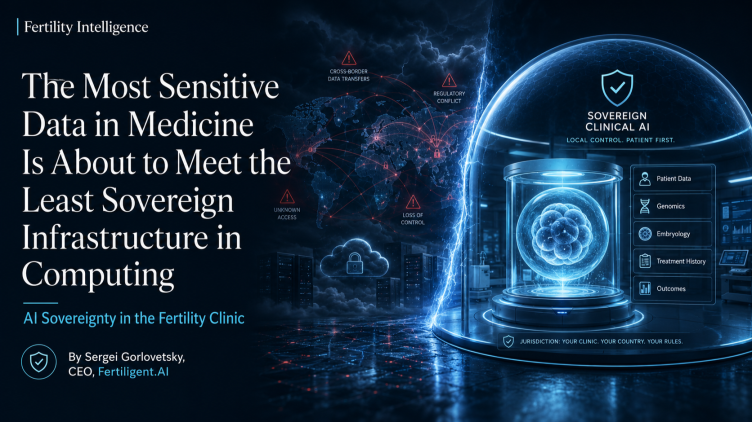
Fertility Data Sovereignty: The Most Sensitive Data in Medicine Meets the Least Sovereign Infrastructure
Under oath before a French Senate inquiry, Microsoft France could not guarantee that French citizens' data would stay beyond the reach of US authorities. That admission, and 23andMe's bankruptcy sale of 13 million genomes, expose why fertility clinics, which hold the most sensitive data in medicine, must control where AI inference actually happens.
IVF EMR software compared (2026): thirteen fertility EMRs, from the vendors' own pages
eIVF, Artisan, IDEAS, BabySentry, Fertility Pro, nAbleIVF, Bloomic, FertilityEHR, Epic, MedITEX, MedART, eBase and Vitrify, on registry reporting, witnessing, hosting, interfaces and the AI each now claims. Every claim from the vendor's own pages, checked 9 October 2026. We do not sell an EMR.
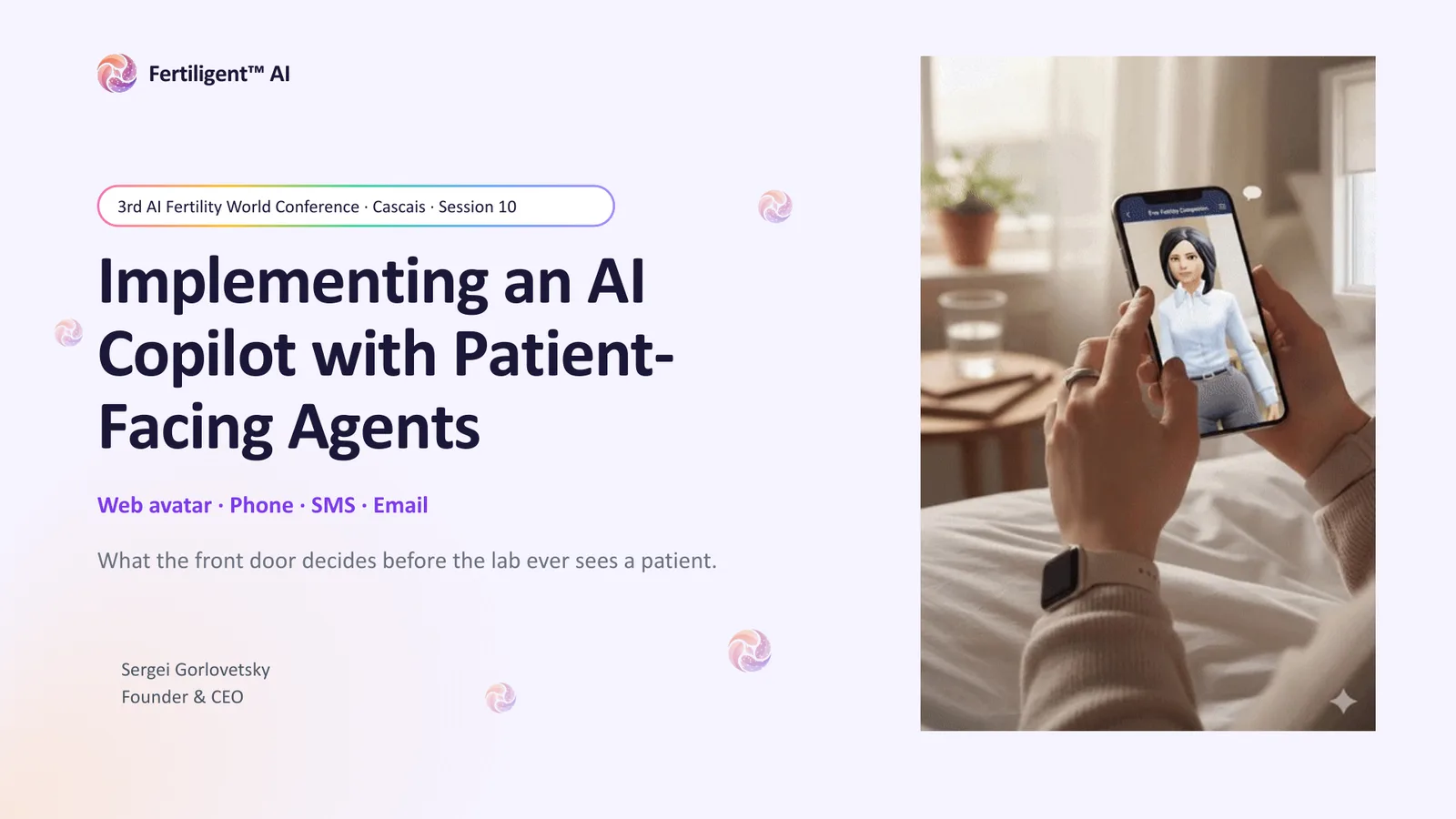
Implementing an AI copilot with patient-facing agents: our talk at the AI Fertility World Conference in Cascais
A narrated recording of our session in Cascais. Why the clinic's front door decides which patients the lab ever sees, one agent across every channel, and a recorded demo of a patient's embryology report explained in her own language after a clinician approves it.
Automating referral intake at a fertility clinic: from the fax queue to a booked consult
A faxed referral arrives as an image, gets re-keyed on Thursday, creates a duplicate chart, and the patient waits for a call that has not come. What the evidence says about lost referrals and delay, the requirements a clinic can hold any intake vendor to, and how we built it.
After-hours phone answering for fertility clinics: what patients call about, and what an AI agent should and should not do
The evening injection question, the Sunday enquiry, the call that is actually urgent. What the evidence says about phones nobody answers, what an AI phone agent should handle from the clinic's own knowledge, what it must hand to a person, and how identity and consent work on the line.

Automating patient follow-up in a fertility clinic: what to automate, what to keep human
Enquiries that never get a call back, referrals that sit in a queue, patients who go quiet after a failed cycle. What the evidence says about speed, reminders and drop-out, which parts of follow-up to automate under consent, and which to keep human.

Emotional support in fertility care: what patients need between appointments
The medicine is delivered in appointments; the experience is lived between them. The two-week wait, the search-engine spiral, why facts alone do not settle a frightened person, the silence around treatment, and what a clinic can do about the hours in between.
Ambient AI scribe or dictation: what changes for a fertility practice
Human scribe, dictation and transcription, or ambient AI, the three options fertility clinics actually weigh. What each costs structurally, where accuracy really comes from, what each one covers, and the consent questions that differ between them.
What an AI scribe has to get right at an IVF monitoring visit
The monitoring visit is short, numeric and cycle-dependent, nothing like the primary-care encounter ambient scribes were built for. What a generalist gets wrong, what "cycle-aware" has to mean in practice, and how the note should be reviewable in under a minute.
AI medical scribes for IVF clinics compared (2026): fertility-specific vs general
Abridge, Dragon Copilot, Freed, Heidi, Nabla, Suki and Fertiligent Scribe, on the dimensions that matter to a fertility practice, cycle context, referral OCR, call capture, EMR write-back, data residency, consent and pricing transparency. Every claim from the vendor's own pages, checked 31 August 2026.

Patient-Support Infrastructure: How Fertility Clinics Scale Without Adding Headcount
Fertility clinics can't scale by adding clinics alone. Staffing is constrained and demand is rising. Here's why patient-support infrastructure, not headcount, is becoming the real driver of sustainable growth.
Why Healthcare AI Works in Fertility Care: Trust, Understanding, and Emotional Intelligence
Advanced technology alone doesn't win adoption in fertility clinics. What actually works is AI that clinics can trust, that patients understand, and that feels emotionally present during one of life's most uncertain journeys.
Fertility Data Sovereignty: The Most Sensitive Data in Medicine Meets the Least Sovereign Infrastructure
Under oath before a French Senate inquiry, Microsoft France could not guarantee that French citizens' data would stay beyond the reach of US authorities. That admission, and 23andMe's bankruptcy sale of 13 million genomes, expose why fertility clinics, which hold the most sensitive data in medicine, must control where AI inference actually happens.
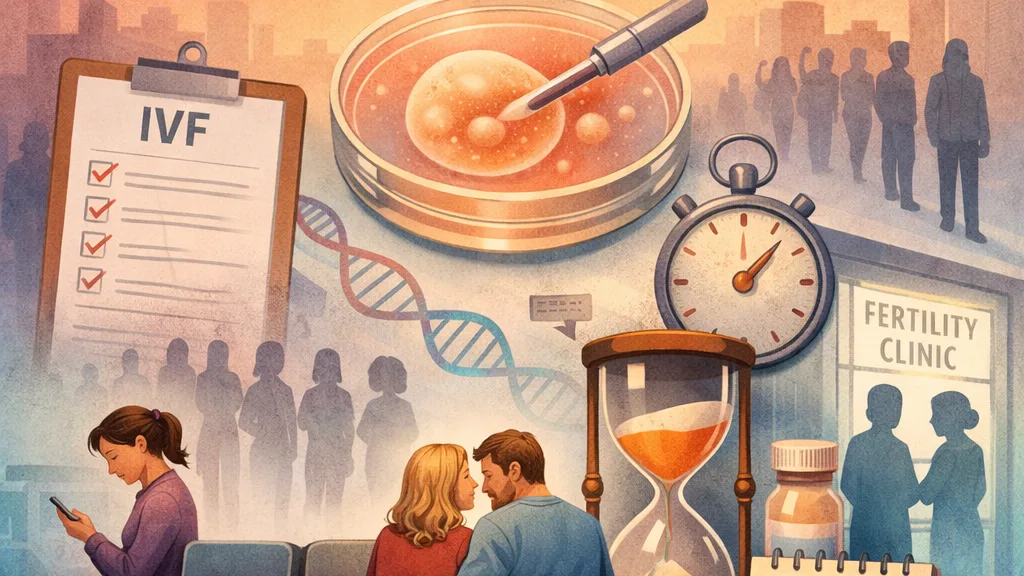
The Waiting Economy of Fertility Treatment
The public imagines fertility treatment as a sequence of medical events. Patients live something else, the unsupported waiting between them, where anxiety peaks and roughly one in three leave treatment before their medical odds run out. The clinic that wins the next decade builds the layer that supports the waiting itself.
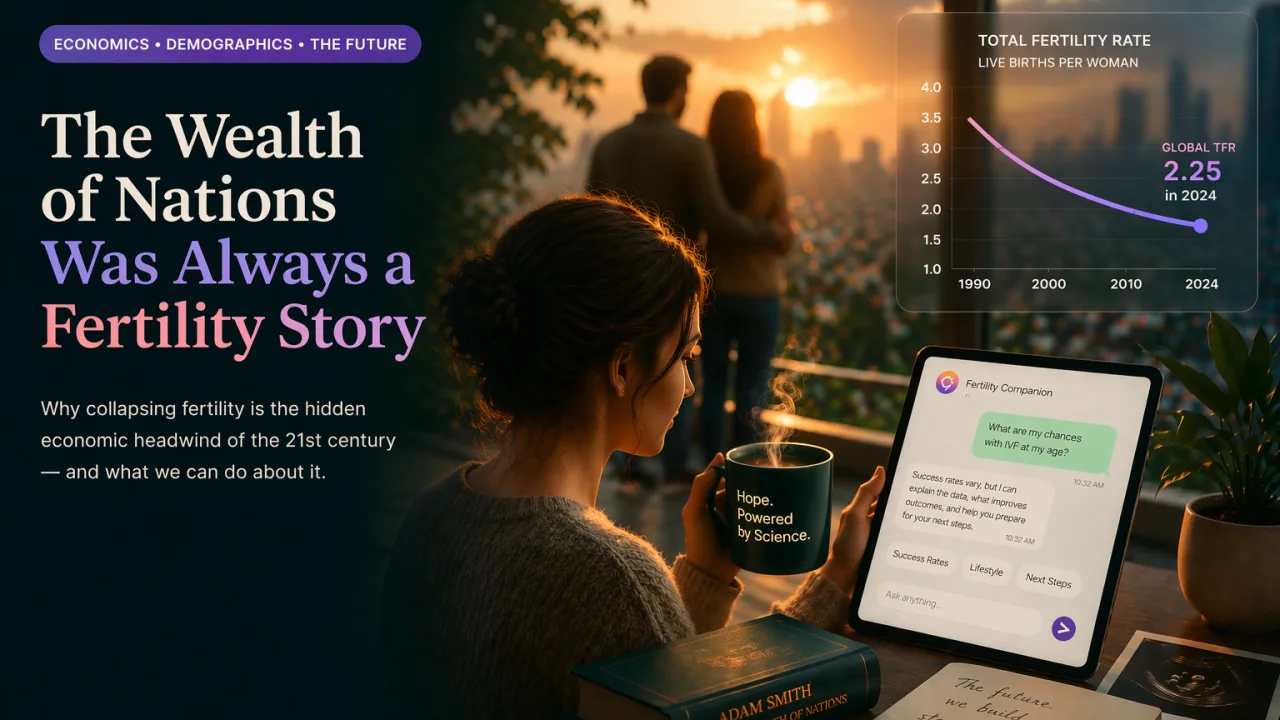
The Wealth of Nations Was Always a Fertility Story
In 2024 the fertility rate in Seoul fell to 0.64, the lowest a major city has recorded outside famine or war. Collapsing fertility is the hidden economic headwind of the century, three decades of pronatalist cash transfers have barely moved it, and the most leveraged, under-invested fix is to treat reproductive medicine as civilizational infrastructure.

Infertility in the Age of the Singularity
Fertility care is at a technological inflection point. AI embryo selection, lab robotics, and emerging biotech like in vitro gametogenesis could raise success rates and reshape a $70B market, but realizing the upside demands rigorous validation, equitable coverage, and updated ethics and regulation. A landscape report.
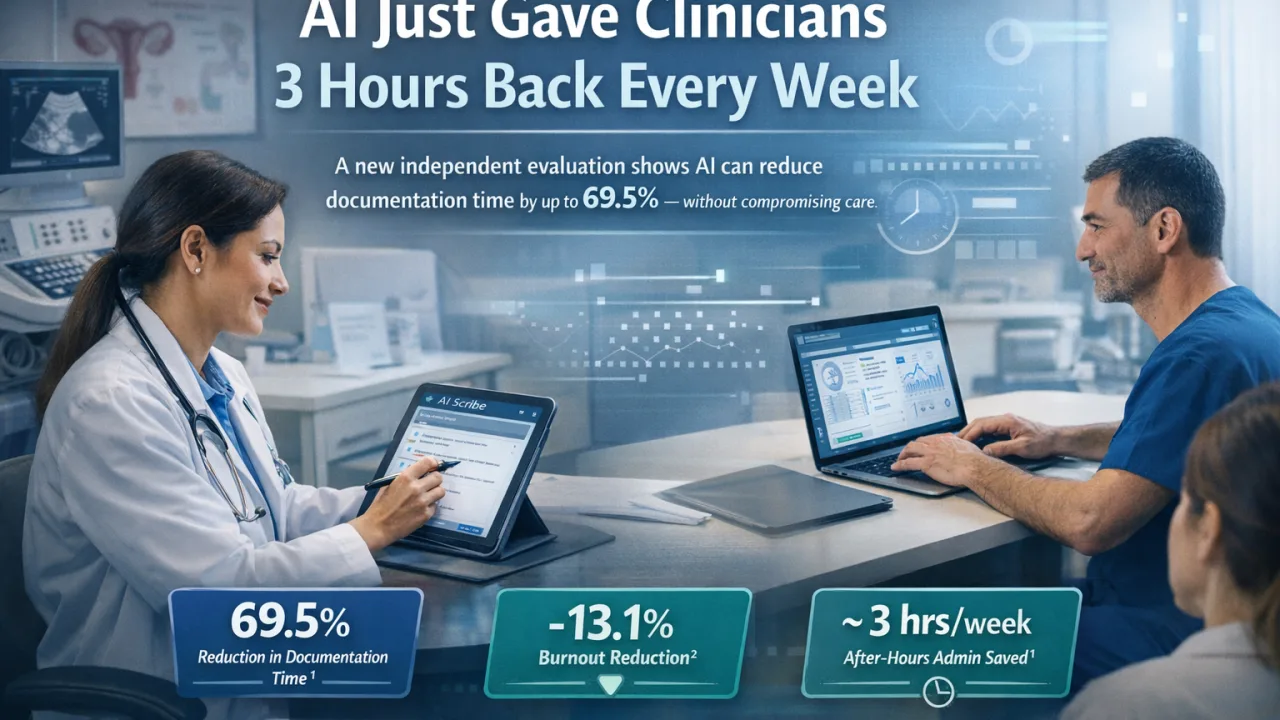
Measured Impact: Clinical Evaluation Proves AI Reduces Documentation Burden
Peer-reviewed clinical evaluations show AI scribes cut documentation time by roughly 10–70% and measurably reduce clinician burnout. Here is the evidence, and how fertility clinics can apply it across documentation, intake, throughput, and patient engagement, with clinician oversight.

Why Patients Sometimes Tell AI What They Don't Tell Their Doctors
Patients are sometimes more open with AI than with their doctors, not because they distrust clinicians, but because AI feels non-judgmental. Here is what the disclosure research shows, and why a responsibly designed fertility companion becomes a first layer of honesty that strengthens the clinician-patient relationship rather than replacing it.