Patient-Support Infrastructure: How Fertility Clinics Scale Without Adding Headcount
Growth Is an Infrastructure Problem, Not Just a Footprint Problem
The next wave of fertility growth will not be driven by adding more clinics alone. It will be driven by the infrastructure that lets each clinic support more patients without proportionally increasing headcount.
That distinction matters more than it might first appear. Opening new locations is a capital and staffing decision, it scales linearly, at best. Every additional clinic needs its own front-desk coverage, its own nursing bandwidth for routine questions, and its own path to a consistent patient experience. As fertility platforms and networks consolidate, the clinics that come out ahead won't necessarily be the ones with the most locations. They will be the ones that built operational efficiency into the way they run, so that growth doesn't require a proportional increase in staff.
Demand for fertility care is rising. The World Health Organization estimates that roughly 1 in 6 people worldwide experience infertility, a scale of need that is not shrinking. At the same time, clinical and administrative staffing remains constrained across the industry. Put those two facts together and the conclusion is straightforward: clinics that want to grow need infrastructure that multiplies what their existing team can do, not just more people doing the same work the same way.
Clinics that scale best tend to share a common set of capabilities. They can answer patient questions instantly, around the clock. They reduce the repetitive administrative work that otherwise falls on nurses and coordinators. They deliver a consistent patient experience across every location, regardless of which staff member happens to be covering that day. And they turn day-to-day operational data into insight leadership can actually act on. None of that is about adding more people to the roster. It's about the systems underneath the people.
The Hidden Cost: Documentation and Repetitive Communication
Ask clinicians what's eating their day, and a common theme surfaces: they spend more time documenting care than delivering it. Fertility clinics are balancing growing patient demand against increasingly complex documentation and communication workflows, and the result is predictable: more administrative burden, more repetitive communication, and less time genuinely focused on patients.
Much of that burden is not clinically complex. A large share of the inbound questions a clinic fields (about medication timing, appointment logistics, what a specific instruction means, or what happens next in a protocol) are variations on a small set of recurring topics. They don't require a physician's judgment to answer, but today they still consume a nurse's or coordinator's time because there's no reliable way to intercept them before they reach a person. Multiply that across a growing patient panel, and the administrative load grows faster than the clinical team can absorb it.
This is the core scaling constraint for fertility clinics. It isn't a lack of clinical expertise. It's that expertise is being spent on repetitive, low-complexity communication instead of the moments where clinical judgment actually matters. Clinicians should be spending their time delivering care, not documenting and re-explaining it.
Engagement Is a Clinical-Operations Metric, Not a Soft One
It's tempting to treat "patient engagement" as a nice-to-have, a satisfaction-survey line item somewhere below clinical outcomes. That framing undersells what's actually happening operationally. Communication, clarity, follow-up engagement, and the patient experience between appointments are operational signals, and the best-run fertility clinics track them accordingly.
There are a few recurring gaps worth watching for specifically:
- Time to clarity: how long it takes a patient to get a clear, correct answer to a question, rather than piecing one together from conflicting sources.
- Instructions misunderstood or missed: protocol steps, medication timing, or preparation instructions that don't land the first time and require follow-up correction.
- Unanswered questions: messages or portal inquiries that sit unresolved long enough that the patient either gives up or escalates through a different channel; we've written separately about which parts of patient follow-up to automate and which to keep human.
- Follow-up alignment: whether the guidance a patient receives between visits stays consistent with what was discussed in the room, across every touchpoint and every staff member.
None of these gaps are visible if a clinic is only measuring clinical outcomes at the end of a cycle. They show up in the space between appointments, and that space is exactly where most administrative burden and most patient anxiety concentrate. Stronger communication in that gap does not just improve how the experience feels. It reduces the number of missed steps and misunderstood instructions that can affect how a treatment plan actually proceeds. Communication, in other words, is not separate from clinical operations. It is part of them.
What "Patient-Support Infrastructure" Actually Means
"Infrastructure" is a deliberately unglamorous word, and that's the point. It's not a single feature or a chatbot bolted onto a website. It's the underlying capability set that makes consistent, scalable patient support possible across an entire clinic or network. In practice, that means:
- Continuous availability. Patients have questions on their own schedule, not just during clinic hours. Infrastructure that can answer routine questions instantly, at any hour, including the calls that arrive after the clinic has closed, removes the backlog that otherwise waits for the next business day.
- Reduced repetitive load on staff. Routing the recurring, low-complexity questions away from nurses and coordinators frees that time for the judgment calls that actually require a clinician.
- Consistency across locations. A patient at one site should get the same quality of guidance as a patient at another (the same instructions, the same tone, the same accuracy) regardless of which staff member or location they reach.
- Visibility into operational data. Leadership needs a way to see where communication gaps are forming (which questions recur, where patients stall out, where follow-up breaks down) so those gaps can be closed deliberately rather than discovered anecdotally.
Taken together, these are the capabilities that let a clinic absorb more patients without a proportional increase in staff. That's the scaling lever this whole conversation is really about.
How Fertiligent Provides It
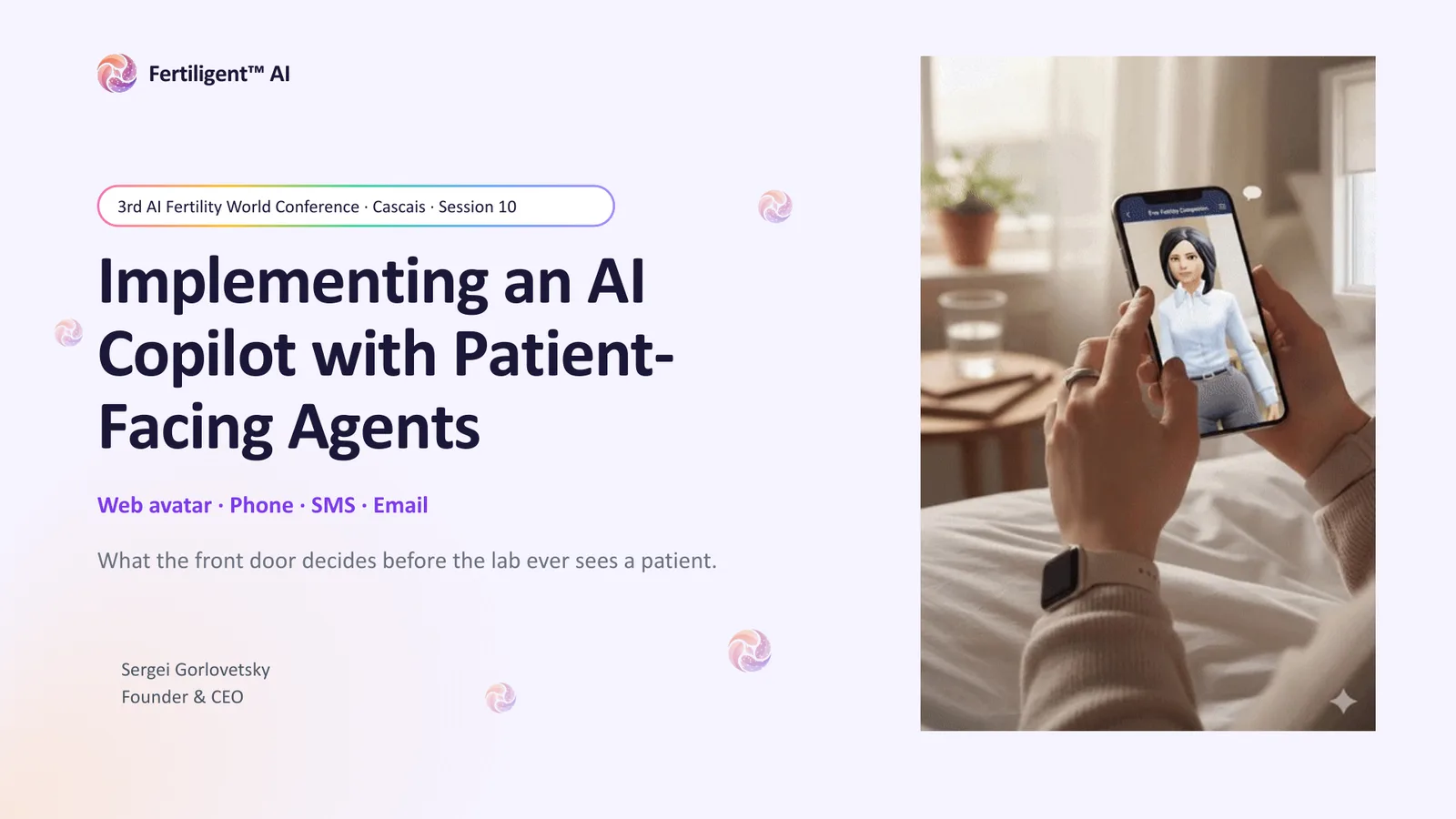
Fertiligent is an AI operating system for fertility clinics: one clinic-governed AI agent working across every patient channel, including phone, fax, SMS, web, and email, in more than 10 languages.
On the patient side, Eva, Fertiligent's AI fertility companion, gives patients plain-language, continuous guidance between appointments: answering routine questions, reinforcing instructions, and reducing the uncertainty that otherwise turns into inbound calls and messages.
On the operations side, Fertiligent automates the front office: answering incoming calls, reading faxed and uploaded referrals through OCR, supporting scheduling, and standardizing messaging so the experience is consistent whether a patient is calling one location or messaging another. It supports care teams rather than replacing them: the clinic defines the boundaries the agent works within, and conversations that need a person escalate to the care team, with deployment options including on-prem and VPC, built to HIPAA, GDPR, and PIPEDA requirements. And because Fertiligent sits across every channel, it gives leadership the analytics and visibility to see where communication gaps are forming (the same gaps in time-to-clarity, instruction comprehension, and follow-up alignment described above) so clinics can close them before they turn into missed steps or added headcount.
This is the underlying thesis: in a market where demand keeps rising and staffing stays constrained, patient-support infrastructure is no longer optional. It's what determines whether a clinic can grow without simply hiring its way through the same repetitive work, one new location at a time.
See It in Action
If your clinic is weighing how to absorb more patient volume without adding headcount, the fastest way to evaluate the case is to see the infrastructure in action.
- Read how fertility patient support software answers across phone, SMS, email and web chat, and where it hands off
- Try the live demo, a fictional clinic with synthetic data
- Talk to Eva directly: eva.fertiligent.ai
- Get in touch with our team: fertiligent.ai/#contact-form