After-hours phone answering for fertility clinics: what patients call about, and what an AI agent should and should not do
A fertility clinic's phone does not stop ringing when the clinic closes. It rings at seven in the evening, when a patient is standing at the kitchen counter with a syringe and a question. It rings on Sunday morning, from someone who has finally decided to ask. Most of those calls go to voicemail, and voicemail is where a clinic's promises go to be forgotten.
This post is about the calls a clinic receives when nobody is on the line: what the evidence says about leaving them unanswered, and what an AI phone agent should and should not be allowed to do with them. We build one, so the interest is declared. The boundaries below are the ones we would want a clinic to hold us to.
The calls nobody is there to take
Four kinds keep coming up.
The evening injection question. The patient has the medication, the printed instructions and a real doubt: whether the dose was 150 or 225, whether it matters that it is now twenty to nine and the sheet said eight. None of it is an emergency, and none of it can wait until nine the next morning.
The Sunday enquiry. A couple who have spent months deciding to call finally do, on the one day the clinic is closed. Some call back on Monday. Some call the next clinic on the list.
"Did my referral arrive?" The family physician faxed it two weeks ago and the patient was told the clinic would call. The honest answer (it arrived, it is being reviewed, someone will call this week); would end the call in thirty seconds if anyone were there to give it.
The call that is actually urgent. Severe pain and bloating after a trigger injection, bleeding that frightens her, a partner saying she cannot stop vomiting. The clinic's protocol for this relies on a frightened caller finding the right option in a phone tree.
The first three are routine and time-sensitive. The fourth is neither, and no answering system should try to handle it. The design problem is telling them apart on the first call.
What the evidence says
After-hours calls are not trivia. The closest study to fertility practice followed 276 after-hours calls to obstetrician-gynaecologists, published in Obstetrics and Gynecology in 2000. More than a third of the calls from pregnant women were triaged to immediate evaluation, and among the 139 women told to follow up at the office instead, 41% said they would have gone to the hospital for emergency evaluation had they been unable to reach their physician[1]. An unanswered line does not make the question go away. It sends it to the emergency department.
Distress has a timetable, and it is not office hours. Boivin and Lancastle followed 61 women through IVF with a daily record chart: seven days of stimulation, seven days waiting for the pregnancy test, four days after the result. The waiting stage was marked by a mix of positive affect and anxiety; from the day of the test onward the predominant emotion was depression; and coping activity rose significantly between stimulation and waiting[2]. The questions a clinic receives cluster around the same transitions, and a cycle does not pause for the weekend.
When patients cannot get through, care is delayed. Before a national telephone-access improvement programme across 13 Veterans Affairs primary care sites, only 80% of surveyed patients said their call had been answered in a timely way, and 41% said their care had been delayed by trouble getting through on the phone. Afterwards those figures were 88% and 15%[3]. A different setting; the same mechanism.
Patients still reach for the phone. A survey of 111 elective orthopaedic patients at a UK hospital, run during the pandemic, found phone calls the most popular contact method in every group, named as the preference by 61%. Among respondents aged 25 to 54, the band most fertility patients fall into, 85% picked phone calls and 72% text messages, with more than one answer allowed[4]. The finding is not phone instead of text. It is phone and text.
Speed matters more than anyone expects. A Harvard Business Review study audited how 2,241 US companies responded to a web-generated test enquiry: 23% never responded at all. In a separate analysis of 1.25 million sales leads, firms that made contact within an hour were nearly seven times as likely to reach a meaningful conversation with a decision maker as those that waited even an hour longer, and more than 60 times as likely as those that waited a day or more[5]. This is sales research and a fertility enquirer is not a lead, but the mechanism, the person who has just worked up the nerve to ask is still deciding, carries over.
What to let an agent handle, and what it must hand over
The rule we use is short: an agent may answer from what the clinic has written down, and must hand over anything that requires judgement about a person.
Let it handle:
- Clinic information (hours, location, parking, how to prepare for a scan, what a service costs) drawn only from documents and fact cards the clinic has approved.
- Referral status, at a high level, "it arrived and is being reviewed", once the caller has been verified. Never the contents of the referral.
- Messages and callbacks: taking a number, reading it back to confirm, and queuing it for staff with the caller's reason attached.
- Bookings the clinic has opened (a nurse intake call, for instance) at times it can state unambiguously.
Make it hand over, at once:
- Anything clinical. "Should I still take the trigger tonight?" is a nurse's question. The agent's job is to get the exact wording and the caller's number to a nurse, not to attempt an answer.
- Interpreting a result. Whether a result is back is a status question, and a verified, consenting patient can be told. What it means for her is a conversation with a clinician.
- Anything that sounds like distress or an emergency. Pain, bleeding, a caller who is crying, a caller who says she cannot do this any more. The right response is to stop, say plainly what to do (call emergency services, or stay on the line while a person is reached) and pass the caller's own words along intact. Not a summary, not a category. The words.
That last point is where most automated phone systems fail: they are built to resolve calls, and a distressed caller does not want to be resolved.
Identity and consent on the phone
Before an agent shares anything personal by phone, two separate things must be true: the caller's identity has been verified, and consent to receive health information on that channel is on file. A caller who has proved who she is but has not consented should be told so and invited to opt in, and shown nothing private in the meantime. A caller the system already recognises as not having consented should hear that at the start, before being asked to prove anything.
Verification is typically by date of birth, spoken or keyed in. A caller from a number already on file may be recognised and spared a repeat check. A caller whose date of birth does not match is told nothing, offered another way forward, and after repeated failures locked out for a period that does not reset when they hang up and call again. Ask any vendor for exactly this sequence.
Consent is tracked per channel with a full audit history (granted in the portal, by text, or by a staff member) and replying STOP to a text withdraws it for texts.
How Fertiligent does it
The voice assistant answers the clinic line. It greets callers, answers clinic-information questions from a curated knowledge base, shares a high-level referral status once a caller is verified, takes a callback number and reads it back, and hands off, leaving a message or callback request, for anything else. For a verified patient with consent on file it can look up upcoming appointments and the status of recent results, confirm an appointment or take a request to change one, book a nurse intake call on the spot, or text public information such as an address. Anything that would touch the record or the calendar is saved as a request for staff to review and apply; the intake booking is the one action it completes itself.
Suspected emergencies are caught before the conversation reaches the AI model at all: a caller describing what may be a medical emergency is told to call emergency services, and the agent stays on the line. That path is separate from ordinary escalation: a suspected emergency is never answered with "someone will call you back".
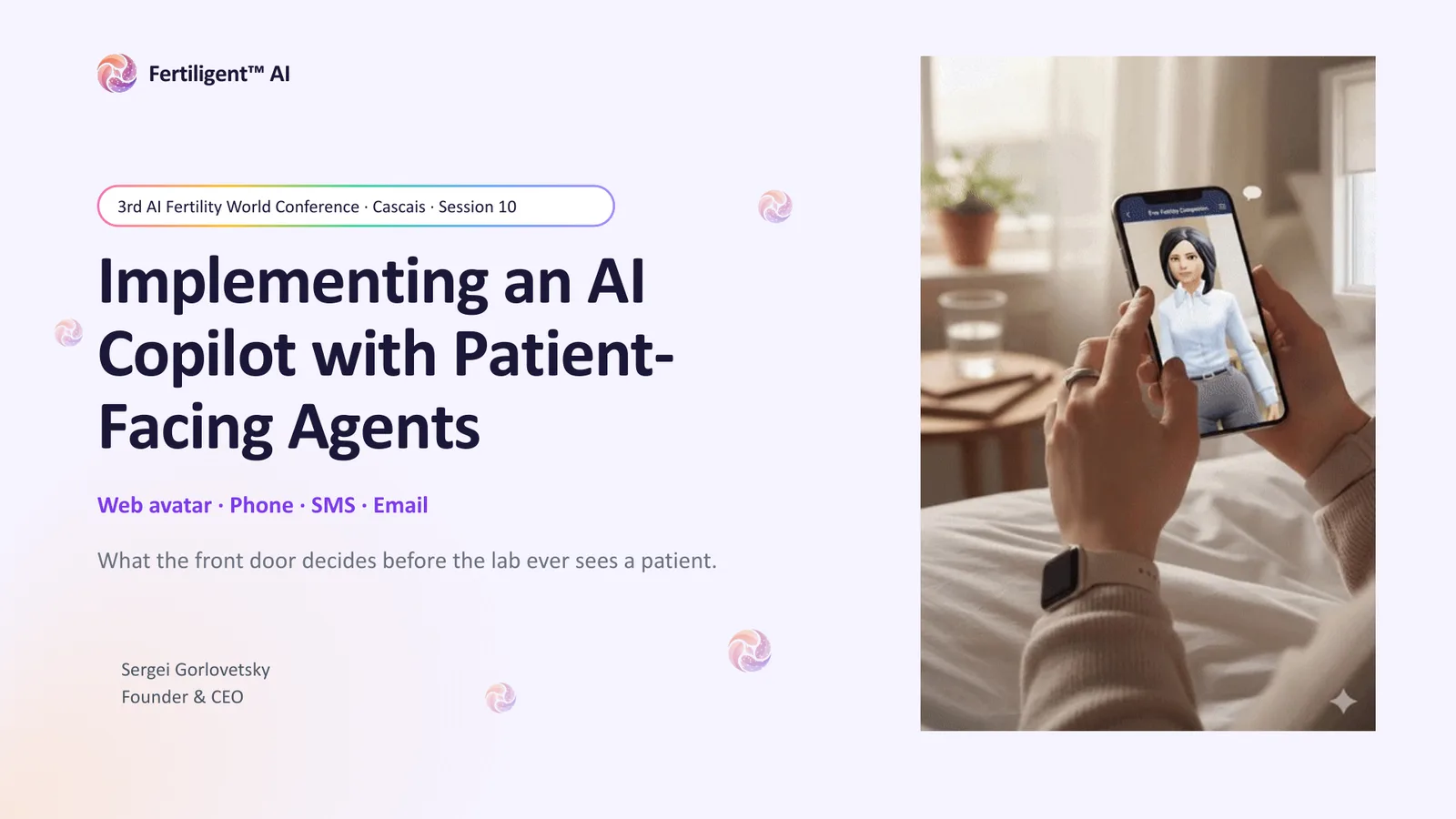
What the agent knows is what the clinic has approved. Uploaded documents sit as drafts until a staff member reviews them and switches them on. Fact cards hold the handful of answers patients ask for most; a changeable fact (a price, a typical wait) lapses and stops being asserted if nobody confirms it. When the knowledge base does not cover a question, the agent hands off rather than guessing. It is the same grounded knowledge behind Eva, the patient companion, so the phone and the chat give the same answer.
Every call lands in the Conversations worklist alongside texts, emails and portal messages, tagged by channel and ordered oldest first, with its transcript and outcome; a Live Ops view shows the day's call totals and how many the assistant resolved or escalated. Staff can take over an escalated conversation, and claiming one pauses the assistant for that person on every channel until it is resumed. A call is attached to a person only through a record or a referral, never on the strength of a phone number alone, so a shared household line cannot put one partner's call on the other's chart. The callback the agent queued is where automated follow-up picks up.
None of this replaces the nurse who answers the injection question. It makes sure the question reaches her in the morning with the caller's words attached, and that the caller heard, at twenty to nine the night before, that it would.
See it yourself: the live demo is a fictional clinic with synthetic data; the recorded walkthrough includes the phone agent taking a patient call, and Eva answers live in your browser. How the same approved sources and escalation apply on SMS, email and web chat is on the AI patient support for fertility clinics page.
References
- [1] After-hours telephone calls to obstetrician-gynecologists, Obstetrics and Gynecology (2000)
- [2] Medical waiting periods: imminence, emotions and coping, Women's Health (2010)
- [3] Improving the quality of telephone-delivered health care, Family Practice (2013)
- [4] How Do Orthopaedic Patients Prefer to Be Contacted During a Pandemic?, Cureus (2022)
- [5] The Short Life of Online Sales Leads, Harvard Business Review (2011)
Related:
- Automating patient follow-up in a fertility clinic: what to automate, what to keep human
- Patient-Support Infrastructure: How Fertility Clinics Scale Without Adding Headcount
Sergei Gorlovetsky, CEO, Fertiligent